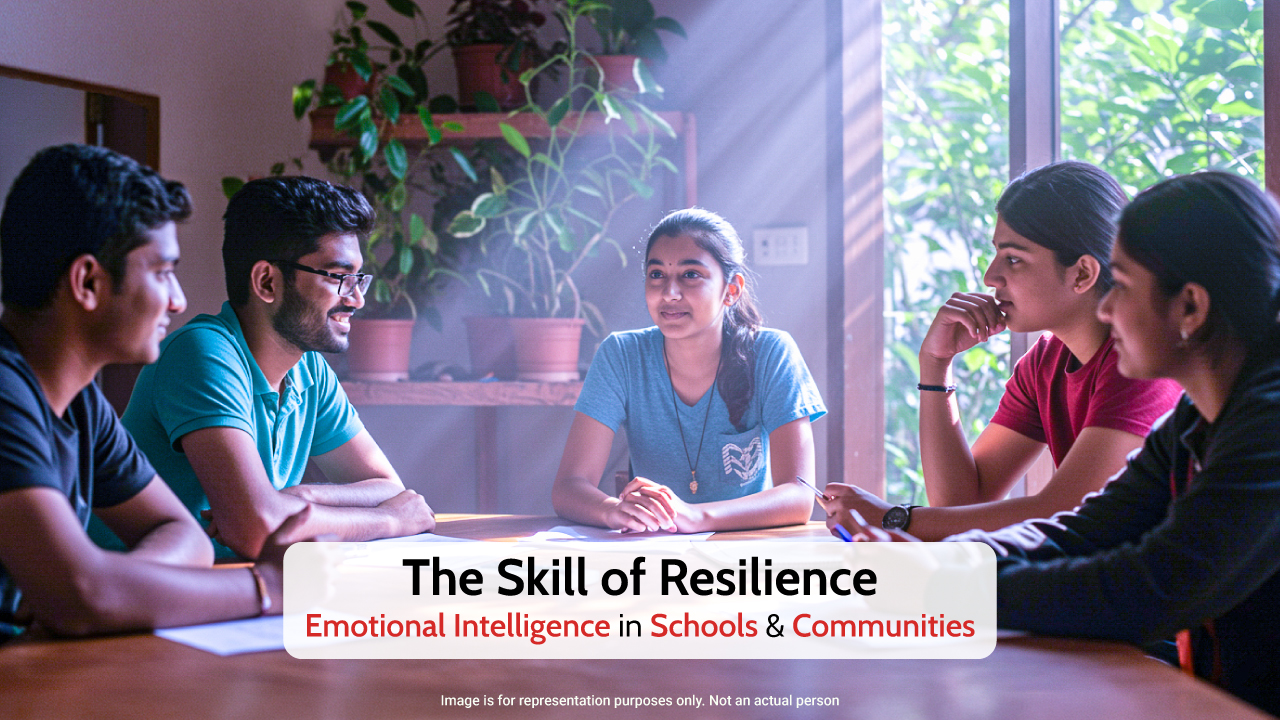
The younger population is required to deliver more than merely academic performance and excellence, which is the demand of today. Students must be taught to adapt, work, and persevere in a constantly changing environment. Emotional intelligence, as the capacity to sense, comprehend, and manage emotions, has emerged as a key principle of holistic growth. Emotional intelligence in schools equips children and adolescents with tools to cope with stress, resolve conflicts, and build healthy relationships. This change in education will involve leaving rote learning behind and focusing on the holistic child.
It was a period when strength was used to imply silence, when feelings were to be borne rather than understood. Children were taught at an early age how to do right, how to follow, and how to achieve expectations, but scarcely how to face fear, disappointment, and self-doubt. When demands came, many found ways to achieve, but not to survive under pressure from academic competition, social comparison, and uncertainty about the future.
Effective Strategies for Teaching Resilience in Schools & Communities
Proactive approaches are necessary for effective resilience education. Social-emotional learning (SEL) equips students with practical skills in emotional regulation, problem-solving, and self-reflection that can be incorporated into schools. Group activities and mindfulness sessions, along with open discussions on issues, create positive environments where students can learn to express themselves and listen to others. These lessons can be strengthened through community agencies by providing support groups, workshops, and mentorship programs to families. When emotional learning is consistent at home, at school, and in the community, people have a stronger sense of belonging and agency.
The concept of resilience is mentioned as a personal trait. Some are blessed with it, and those who are not. However, resilience is not inborn or otherwise. It is an art, an essential skill that may be taught, trained, and developed.
With emotional intelligence, one can start by naming feelings and realising that stress is not weakness. Anxiety is not a symptom, but an indicator. Most emotions carry information about needs, limits, and values. Once people learn to acknowledge their inner world, they can respond rather than react.
Conversations evolve in an emotionally intelligent, nurturing school, community, and environment. Errors make learning opportunities. Conflict becomes dialogue. Weakness is transformed into strength. Children grow into adults who can handle pressure, work with empathy, and guide with awareness.
Resilience is not about never falling; it is the ability to get up and learn from it without embarrassment. It is all about developing tools to sail through change, loss, and uncertainty with dignity. Emotional skills are life skills, especially in situations with limited resources.
Long-Term Benefits of Building Emotional Resilience in Students & Communities
Developing emotional resilience is an investment in personal and social health. Studies indicate that emotionally intelligent people are less anxious and depressed, perform better academically, and have stronger leadership capacity. Societies where emotional learning is highly valued report higher levels of trust, collaboration, and social unity. As we empower youth with resilience, we not only equip them to overcome all odds but also enable them to flourish even amidst them. This active model of education and community development is a precursor to healthier and more adaptive societies.
Societies that educate emotionally provide more secure areas. When people feel heard, respected, and emotionally supported, they are expected to get involved, be innovative, and care for one another. Emotional intelligence is an invisible infrastructure of collective growth. Teaching resilience at a young age does not eliminate all problems, but it equips students to cope with them without losing their identity.
SivaShiksha’s Role
SivaShiksha understands that education should develop the inner world as it does the outer. Its programmes incorporate emotional intelligence, self-concise, and resilience into learning systems across age groups. Treating emotional skills as teachable and necessary, SivaShiksha rejects the notion that mental strength is either natural or not.
SivaShiksha helps people develop the language and tools to understand their emotions and cope with life's pressures through community-based learning, reflective practices, and supportive environments. It is not about short-term performance but about long-term well-being. By integrating emotional intelligence into education and community development, SivaShiksha can help build strong individuals and a society capable of adapting to a rapidly evolving world.