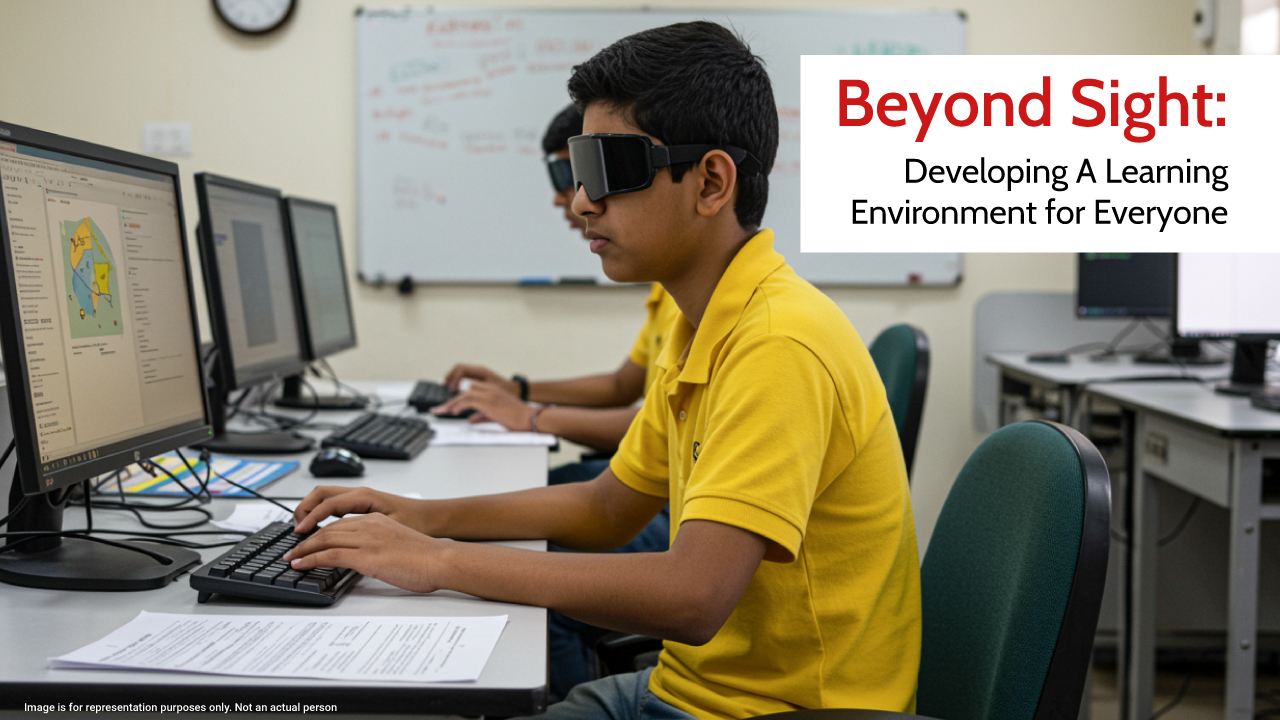
In most Indian classrooms, what is visible at the start of learning is what matters. On the blackboard, textbooks are filled with diagrams, and the lessons usually rely on visual sensations. This system is an automatic workaround for most students. However, for blind people, it may be a different story, as they lack the educational experience.
It is like walking into a classroom and feeling like everybody understands something beyond you. The teacher is describing a chart drawn on the board. Peer students are flipping through pages of pictures. When one points to a picture in the book, laughter ensues. But none of it is altogether available. The educational world is everywhere, yet so close and yet so far.
To a large number of blind and visually impaired students, the process of education starts with overcoming these invisible obstacles.
Barriers to Accessible Education in India
Thousands of children with visual impairments across India are willing to study, explore the world, and reach remarkable heights. However, the structures are designed to help them fail. Textbooks might not be available in Braille or audio. Digital platforms might be incompatible with screen readers. Teachers are not necessarily trained to use inclusive instructional strategies. Starting as a mere difference in access, it gradually becomes an opportunity gap.
But the issue is not ability; the issue is accessibility.
An environment built with sighted students in mind unintentionally excludes students who perceive the world differently. The lesson, with all its written content or graphics, becomes challenging when alternative forms are absent. The blind students will find it hard to participate in a science experiment that is purely visual. Even classroom interactions can cause isolation when peers are not stimulated to learn and embrace diverse learning patterns.
Inclusive education, however, is not concerned with establishing another system. It is a process of redesigning available spaces to ensure that all learners can be involved.
The environment is different in classrooms that adopt the idea of inclusion. The educators explain things in simple verbal terms. The tactile materials enable the student to touch shapes, maps, and scientific models. Lessons are activated through audio resources. Screen readers, refreshable Braille displays, and voice-enabled devices are some technologies that can help close the information access gap.
Empowerment & Independence through Technology
These devices are not just supportive of the learning process but, to a certain extent, also help reclaim a sense of independence.
When a visually impaired student reads a digital textbook with a screen reader, they are not just getting the content; they are also gaining the autonomy that other students enjoy. A drawing does not merely replace a drawing; a tactile diagram of a geometrical figure is a gateway to learning complicated concepts by feeling them.
Most of all, inclusive learning environments promote empathy among all students. When the classroom is designed to accommodate diverse needs, students are taught that there are numerous types of abilities. Teamwork substitutes isolation. Wondering takes the place of indecisiveness. Inclusion is a collective responsibility rather than a special accommodation.
Nevertheless, technology is not all that is needed to develop such environments. It involves awareness, training, and community participation.
Teachers require resources and support to change their teaching approaches. Accessible materials have to be invested in schools. Societies must understand that blindness is no barrier to intelligence, curiosity, and ambition. When all these factors collide, classrooms begin to become places where all learners are appreciated.
In the world, one can find numerous cases of blind people who have been great academicians, artists, scientists, businesspeople, and leaders. It is not that their success was due to exceptional conditions, but rather to conditions that supported them and eliminated extraneous challenges.
The real issue is to ensure that such environments are not the exception but the rule.
Shifting the Paradigm: Making Inclusive Education the Norm
Learning must not rely on sight. It must be anchored on the learning capability.
This is where the grassroots organizations can be useful. When they close the divides between communities, educators, and resources, they can help establish more inclusive education systems.
SivaShiksha: Championing Accessible Learning Environments
SivaShiksha aims to create learning environments where all people, regardless of ability, can learn with dignity and confidence. The organization promotes the discussion of inclusion and equality of opportunity through community-based efforts, awareness campaigns, and advocacy of accessible education. It aims to encourage digital literacy and the use of adaptive learning tools, and to empower communities to understand the value of accessible education.
SivaShiksha seeks to ensure that visually impaired learners are not defined by their limitations but that their potential is recognized by creating awareness and enhancing local support systems. Inclusive education does not merely mean accommodating difference; it also means glorying in it. Learning becomes an environment where all voices are heard, all views are appreciated, and all students are empowered to envision a world that is not physically in sight when communities come together and clear the barriers.