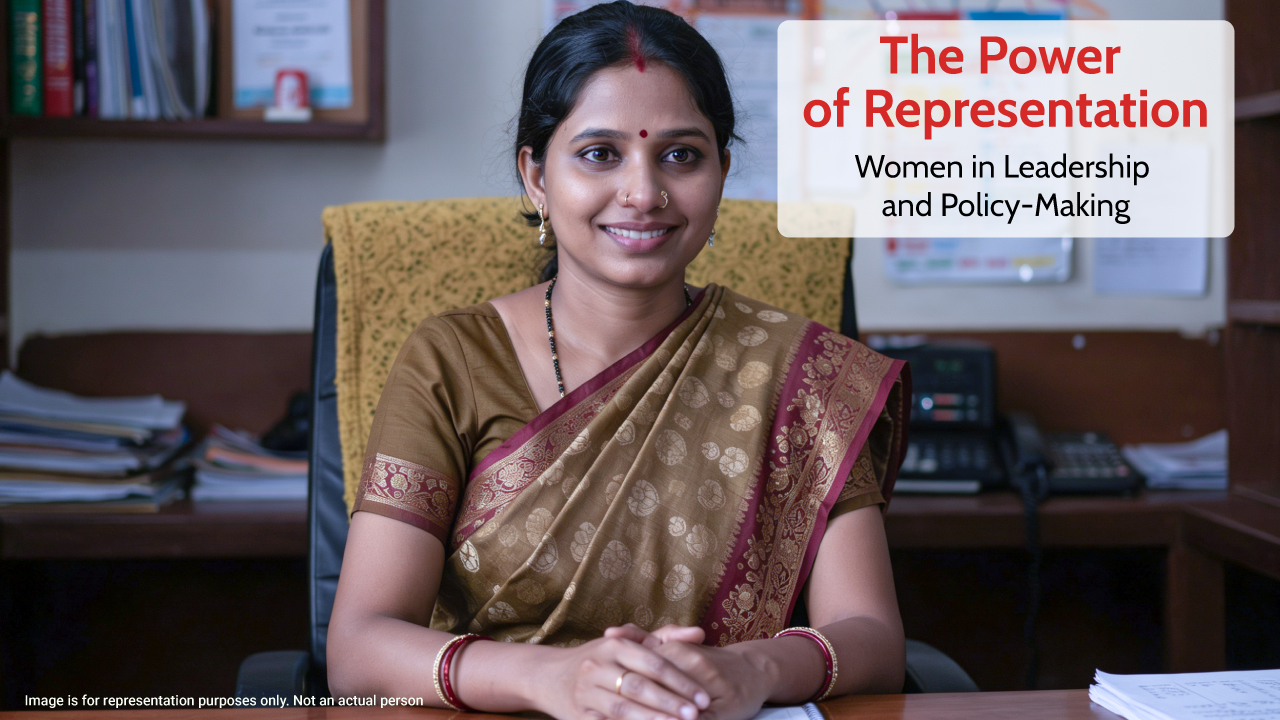
Asha was not just a newly elected leader when she walked into the local council office the first time. She was a silent symbol of change. Her sari was plain, her voice low, but her belief was great. For several years, she had observed others making decisions about how the resources of her village should be used, which roads to construct, and which schools to finance. Now, when she sat at the same table, she did not express her own ideas alone, but the hopes of numerous women who had never been heard.
Such incidents as Asha’s are occurring across India, where women are taking a leading role in decision-making in politics, governance, and community leadership. These women do not simply enter into the systems of power; they transform them. They present perspectives shaped by their experiences as mothers, caregivers, professionals, and citizens. Once these experiences shape policymaking, the policies start to target actual human needs rather than mere plans.
Why Representation of Women in Leadership Matters
Representation does not merely mean the number or percentage in parliament or the boardroom. It concerns the presence of people in making crucial decisions. Women make up nearly half of the population in India, yet they still have little representation in leadership. However, things are changing. Women leaders are demonstrating that inclusion is innovative, whether in local councils, Parliament, start-ups, or social enterprises.
Women are better positioned to make decisions when they hold leadership roles. It has also been observed that women in policy-making positions tend to focus on other areas, such as education, health care, sanitation, and social welfare, which play a vital role in community welfare. Their leadership is usually more participative, open, and sensitive. This is not only in their interest but also in the interest of better governance.
Yet, barriers remain. The systemic problems are still prevalent among many competent women, who lack political networks, gender bias, and social pressures to remain in traditional roles. Women having rural or marginalized backgrounds or economically weaker backgrounds often have a steep path to leadership. Despite all this, they continue to do so not just for themselves but also for their successors.
From Presence to Power: Empowering Women in Leadership
Change occurs only when women are involved in leadership, and, most importantly, when they are able to make decisions. The mere presence brings visibility, whereas power brings change. When women are in the lead, whether as mayors, MPs, corporate heads, or policy advisors, girls see that it is possible. In this context, representation is not only a political issue but also a deeply personal one.
Take Malini, for example. She is a 25-year-old who entered a policy think tank led by young people after completing her studies. Initially, she was unsure whether her voice was counted among the senior men in the room. However, over time, she realized that her perspective as a young woman was neither unjustified nor essential. Her insights were critical to the team's formulation of recommendations on gender-responsive budgeting, which were later adopted by a state government. This is the spillover of representation: a woman's bravery can move a great number of other women.
Female leaders also transform perceptions of strength in governance. They show that leaders can be grounded in empathy, cooperation, and ethical courage, but not in authority and hierarchy alone. These are highly important qualities for a country such as India. With increasing women's representation in decision-making bodies, they demonstrate that inclusive governance is not a luxury but an imperative for any meaningful improvements.
SivaShiksha: Empowering the Next Generation of Women Leaders in India
In our view, at SivaShiksha, representation begins with preparation. Any young woman must not just dream of leading, but also be prepared to lead. Our programs strive to bridge the educational and empowerment divide by improving women's confidence, communication, and critical thinking. We encourage young women through workshops, mentorship, and practical learning about how policies are formulated and how their voices can influence policy outcomes.
The leadership and civic engagement programs of SivaShiksha are designed to develop self-awareness and social responsibility. The participants are taught to approach real-life problems, such as community projects and advocacy campaigns, thereby preparing them to engage in governance. In our opinion, leadership does not lie in the title; it lies in taking responsibility and making a difference where it is needed most.
Through its approach to promoting digital literacy, civic knowledge, and ethical leadership, SivaShiksha can enable women to become changemakers, prepared to lead discussions, confront inequalities, and develop inclusive solutions. Women create wealth when they are at the helm; they develop a country when they are at the policy table.
The future of leadership in India lies not only in the number of women involved but also in their ability to influence the world they inhabit with confidence. With the voices of Asha, Malini, and thousands of others, India is also changing, not only to be represented, but to transform. And SivaShiksha is right next to them, illuminating the way to a more equal, empathetic, and empowered future.